
Your body consists of 60 thousand billion cells, such as muscle cells, white blood cells or cheek cells.
Amazingly, nearly every single cell contains your entire genetic information, the DNA.
Within the cell, most DNA is tightly packed into 46 chromosomes in the cell nucleus (containing nuclear DNA) but there is also some DNA outside the nucleus, in tiny organelles called mitochondria (containing mitochondrial DNA).
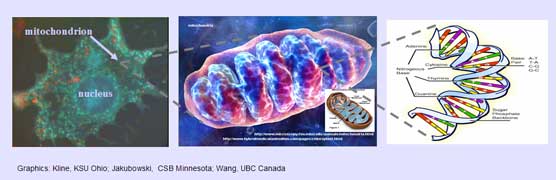
Our nuclear DNA is inherited from both parents, but mitochondrial DNA (mtDNA) is passed down only from our mother.
Very soon after fertilization, the sperm's mitochondria are lost, and the developing embryo is left only with maternal mitochondria. Hence, we share the same mtDNA with our mothers, brothers and sisters, but not with our fathers.
MtDNA is thus passed down from mother to daughter, generation after generation, with little or no change.
You can think of this as the female counterpart to surnames which are traditionally passed down on from father to son. And just like a surname can occasionally change, for example from Forester to Forster, our mtDNA occasionally undergoes a natural mutation and becomes a new mtDNA type which in turn is passed down.
Therefore, our personal mtDNA code will track our direct genetic line back until the point at which a natural mutation in the mtDNA code occurred - on average about every 10,000 years in the control regions of the mtDNA.
Surnames do not go back further than a thousand years or so, whereas mtDNA reveals a much more ancient ancestry: all living human mtDNA types ultimately trace back to one woman who lived around 150,000 years ago, who is commonly referred to as Mitochondrial Eve.
Why a single woman? – Imagine that there are exactly 6 billion humans alive today; if each of us humans had a different mother, then we would have exactly 6 billion mothers in the previous generation.
However, in reality some of us have the same mother, so in the previous generation we most certainly have less than 6 billion mothers.
The same argument applies when we go back another generation – the number of mothers can at most stay the same, but in fact typically decreases whenever two or more people have the same mother.
If we follow this simple logic back through the generations, we end up with one mother, Mitochondrial Eve.
In the past 150,000 years, Mitochondrial Eve's descendants populated the entire globe, spreading geographically and branching genetically continent by continent and region by region.
These prehistoric branching events can be read in the ancient mutations of our mtDNA like in a history book, leaving genetic footprints wherever they went. See Ancient Migrations for more about how we can trace the expansion of the world's stone age population during prehistory.
“Genetic Ancestor” uses the latest genetic research and laboratory techniques to help identify your maternal lineage through our mtDNA tracing service.
By analysing and comparing your mtDNA with our database
of many thousands of other mtDNA samples from all over the world, we can
tell you much about your ancestry and your living distant cousins.